Dec 3, 2009

Indoor Plants - Adding that "green" touch to your decor

I am a huge fan of greenery, both indoors and outdoors. Flowers have never been a great draw for me, at least not as much as I love "greens". Living in a small apartment, I rely on my tiny balcony and the area inside the apartment for adding that green fervor around me. Ok, let me brag about it now! I tried growing a balcony garden and did reasonably well with that. Here's a sneak peak into the balcony.

I had re-purposed milk and yogurt cans from friends and my kitchen so that I could extend life of these plastic wares and also avoid buying new pots. (Reduced demand indirectly-right!..thats the economics bug in me speaking)


Indoor plants not only look pleasing but also work as natural air purifiers. Researches have proved that indoor air quality in most homes across the world is as polluted as the outdoors. Extensive use of vinyl, plastic, foam and other products has lead to increased presence of carbon monoxide, Benzene complexes, formaldehyde and trichloroethylene. Trying to use environmentally safe products and materials goes a long way in minimizing these toxins' entry into our homes. Plants work as excellent natural purifiers and allergen killers.

You can bring in common low maintenance ornamental plant variety to work for you. The list include common money plant, snake plant (also called the mother-in-law's tongue), most varieties of succulents and the very popular English ivy.

Other recommended varieties : 
Bamboo

Rubber plant
Image source: cryleaf.com

Boston fern
Imagesource:ecofriend.org

Spider plant
Image source: cbgarden.org


Peace lily - Although this is among the most popular indoor greens, this plant oozes a sap which is poisonous to humans and pets.
Image source:rossu.edu 
Aloe Vera : This among my favourites because of its succulent look and it medicinal properties.
Image source: envymags.com
florist mum: Best seasonal plant for removing benzene, ammonia and formaldehyde.

Image source: calyxflowers.com
English ivy: looks very similar to our common money plant with a textured leaf. It is known to eliminate formaldehyde (sources: paints, leather goods etc.). I found a beautiful painting of the Ivy

Image source: arkansasarts.org

Dracaena: Comes in different varieties and is known to eliminate indoor toxins. this plant is ideal for a "black thumb" gardener and can grow for decades. You have a wide variety to choose from.
Image source: gertens.com
 
Golden pothos: Our good old money plant. It is the easiest to grow, and ranks high as an all-round air cleaner.
Most researchers and Physicians advice you against having plants in your bedroom. For that matter even Feng shui and vaasthu shaasthra do not encourage having plants in your sleeping area. This is simply because, plants exhale CO2 at night and compete with us for the available oxygen. They work for us during the day by inhaling carbon-di-oxide and releasing oxygen (remember our good old science books! ;).

Level of exposure to sun and water, and plant feed frequency depends on the plant variety you intend to grow and your geographic location. Another research which would make an interesting read is Plants Plants: Pros and Cons.

Try growing some green indoors. You will fall in love with your home all over again. As far as possible, try avoiding having faux plants and silk trees at home. They end up being dust depots and can actually deteriorate indoor air quality.

Live well and be happy!

Dec 2, 2009

Chippewa Dream Catchers

On our way back from the Smokey mountains in Tennessee, we took a break in Cherokee, North Carolina. I was excited to see a Native American arts and crafts store owned by a Cherokee Indian (the shop was lined with his family pictures....He sure was proud of his lineage!). I have been waiting to visit historic sites or at least a museum for a long time and am looking forward to our trip to Cherokee

Among the things on display, all we could afford were a small boomerang and a Chippewa dream catcher. I had seen these earlier, but wanted to buy a handmade authentic piece and not a mass produced "made in china" Native American artifact. The seller's inputs were just what I needed to begin my research.


Peak into its history..
Chippewa dream catchers have a number of legends and folklore spun round them. No one seems to have a clear idea about how and when this object was first made. It is really sad that native American tribal history has been lost, forgotten or changed. Researching about American history always led me to books and resources documenting events after the Native Americans were forced from their lands and the Pilgrims and settlers occupied every inch of new found territory. As time passed, native population diminished in numbers. Survivors of different clans banded together to cling to what remained of their origins and this brought in new traditions reflecting the melting cultural elements. (There are a few reservation sites though!!)

Time took its toll and native culture, heritage and legends faded into oblivion. There are a few books and literary items which speak about native tribes but all are not found on book stands (at least where ever I looked for them). There is very limited documentation available in terms of research and historic evidence presented from Native American perspective.

Legends about dream catchers were forgotten until 1929,  when ethnographer Frances Densmore came up with documented account of this Native American Charm. She says that these ornamental charms were hung over cradles by the Chippewa Indians. They believed that these charms were powerful enough to filter and hold out any evil that comes in contact with it. This spider web like object was believed to guard children from evil spirits. I read about similar beliefs prevailing among natives throughout the Americas and as far as Mexico. One thing was common, their faith in super natural power and a belief that spiders would protect them while they were asleep. Sioux Indians believed that a dream catcher would hold their destiny. Every legend was in some way connecting man to the super natural elements.

Another legend says " these dream catcher filters out the bad ba-we-dji-ge-win (dreams) and allows only good thoughts to enter into our minds while we sleep. A small hole in the center of the dream catcher is where the good bawadjige may come through. With the first rays of sunlight, the bad dreams will perish."

I found another website which said, dreams were messages from sacred spirits. This Legend says that a hole in the center of the Dream Catcher allows good dreams to reach the sleeper and bad dreams get trapped in the web and disappear at the break of dawn. You can read more on dream catchers in this link : dream catchers.

This is an authentic handmade piece used to ward off evil.
Imagesource: easyfreeware.com

Decorations and their meaning...
Each dream catcher is said to be unique and decorations and materials used have special meanings. The hoop is generally made of willow and is wound with leather for good aura. A single bead in the middle may represent the spider that is on the web. Scattered beads represent good dreams that have been caught throughout the night. A feather represents a symbol of breath of air and hence signifies the need for good air (quality). I believe that Native Americans understood the need for spiritual, emotional and physical well being. We all do...right!...the more we try to change the same we remain!

Nov 28, 2009

Amazing Antiques ~ Bentwood furniture

Bent wood furniture adds a pop to the ambiance. It is an interesting twist to having usual rockers and chairs. To clear any doubts, Bentwood furniture is not made of CANE. It is actual wood and caning is done on the backing or the seat area. People often ask me if the rocker is made of cane. Not it is not!

I saw an ad for a bentwood rocker on craiglslist..and got floored. Could I resist buying one? no I couldn't. I bought this Thonet reproduction from a graceful old Lady in Marietta. It is an upholstered piece with a layers of plywood stripes bent to make the rocker.


Having bought this reproduction rocker, I researched for the original versions and its transition into modern design era. I bought this one recently (see below) from a couple. I am glad I bought both. Each piece has an individuality.


I would love to keep them both, I have to let the older one go due to space constraints..(sniff)..

Delving into history of bentwood furniture...
In 1830's, Michael Thonet and his sons were experimenting with this exquisite method of making chairs in their workshop in Boppard, Germany. Their first bentwood chair was released in 1850 and was called Chair no 1. Bentwood furniture was a huge success in those times because it broke free from the traditional furniture making methods. In those days, furniture was made with flat planks and pieces of wood and the joints were disguised by elaborate carvings. With the Bentwood design, Thonet introduced sleek, practical, inexpensive and refined looking furniture to the world.

image source: treehugger.com

Compare Thonet's design (above) to a traditional chair from the Renaissance period (below)
Image source: countryliving.com

Thonet Moves to Vienna..
Despite their initial success, Thonet's company faced a lot of difficulty patenting this technology in Germany, great Britain and France. In 1841, Thonet met Prince Klemens Wenzel von Metternich at the Koblenz trade fair. The Prince was so impressed with Thonet's bentwood furniture design that he invited him to present his furniture ideas to Vienna’s royal family.The Vienna Royalty were known for patronizing art, music and other art forms during their reign.

As a result of this invitation, Thonet family worked on the interiors of the Palais Liechtenstein for the Carl Leistler establishment. In the meanwhile, several failed attempts to patent their design method and increasing financial difficulties forced Thonet to shut the workshop in Boppard and move his business and family to Vienna in 1942. Most of the other thonet classic chairs were produced in Vienna, hence the name - Vienna chair, although Thonet chairs have their origins in Germany.

Gebrüder Thonet was founded in 1849. In 1850 he produced his Nr 1 chair and the famous chair Nr. 14– also known as Konsumstuhl Nr. 14 was produced in 1859. This design became so famous as coffee shop staple, that it is still called the "chair of chairs". Here is the famous Konsumstuhl -14

image source: wiki
This chair was relaunched as chair number 214. Other pieces included cribs, day beds etc.
Imagesource: designarounddenver.com

                                                                  oneofakindantiques.com

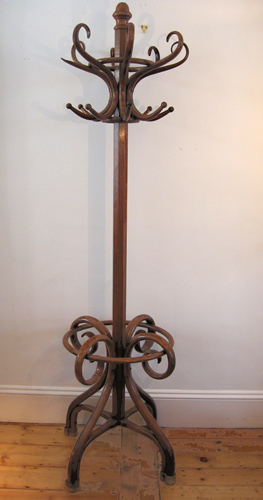
a coat rack
image source: thonet.de

image source: arthurswirgonltd.com


Michael Thonet patented the bentwood method of furniture manufacturing in 1856. After the patent expired in 1870, two other manufacturers Mundus, Kohn and few other companies entered this business to produce their line of bentwood furniture. Another very interesting fact about thonet was that  - they were the first to produce and market Flat pack furniture, almost a few decades prior to IKEA's flat pack kits. It is a design marvel of sorts when this flat pack design was invented. Consumers raved about how a very sturdy yet sleek chair could be assembled with a few screws.

About the design...
Bent wood is basically steamed bent pieces of wood, for arms, legs and other supportive parts of the chair. Steamed wood is bent along with metal sheet and rod supports in place. Here is a video about Thonet's furniture (in french )

courtesy:youtube

And a segment featuring Thonet chairs from a program called Roving Eye from abc.net (Australia TV)

These bent pieces of wood are used to make sleek, decorative chairs and other pieces of furniture. These furniture have been design magazines staple since its invention in the early 1800s.

Earliest models


Image source: katyelliott.com

Any wood of choice was used to be soaked, steamed, molded and bent to make these furniture pieces. Beech was however considered an ideal choice. You must have seen a wide array of designs in bentwood furniture cafes or bistros.There have been metal and even plastic imitations of these chairs found in small restaurants and coffee houses across the globe. I am not drawn to these cheap imitations as they remind me of road side cafes in Hyderabad. They can never match the wooden versions

Most of the bentwood furniture from the 19th century was made in France, Poland and Austria at various Thonet factory locations and sold all over the world. Strategic mergers led to consolidation of Thonet and its competitors Mundus and Kohn. Mundus and Kohn merged in 1914 and later consolidated with Thonet in 1922.

Thonet is still the largest bentwood products maker and has expanded its product line with plywood and tubular steel furnishings. Post merger, Thonet has produced other classics including this Cantilever chair by Marcel Breuer. B32 Chair, 1928, made of Chromium plated steel, wood and cane.

A cantilever chair has no back legs and relies on the properties of the material from which it is made for back support. In fact, the chair challenges the concept of tensile strength (of a piece of furniture).

Image source; wiki
Mark Stam, the designer of a similar tubular chair was awarded a patent for his design in 1932. There are, however conflicting versions of who invented this design. Mark Stam is said to have come up with the design for a cantilever chair as early as 1926. Here is what wiki says - Cantilever chair

As always there have been reproductions of this classic as well. I remember seeing one such chair in most government organizations in India.

Rockers have been a part of Thonet's product portfolio ever since they started the bentwood chair manufacturing . Coming to my rocker, it is called the Thonet rocker nr 10. It has been an exhibit in my university's college of fine arts department museum.

image source: uiuc.edu

I am glad I bought a thonet rocker. Hope it stays with us for years to come.
adding pinterest script 3. Changing the Position of the Pin it! button The cool thing about this code is that you have some freedom over where the Pinterest button for Blogger will go over the image. Take a look at the code that you just copied and pasted into the HTML for the word 'center'.